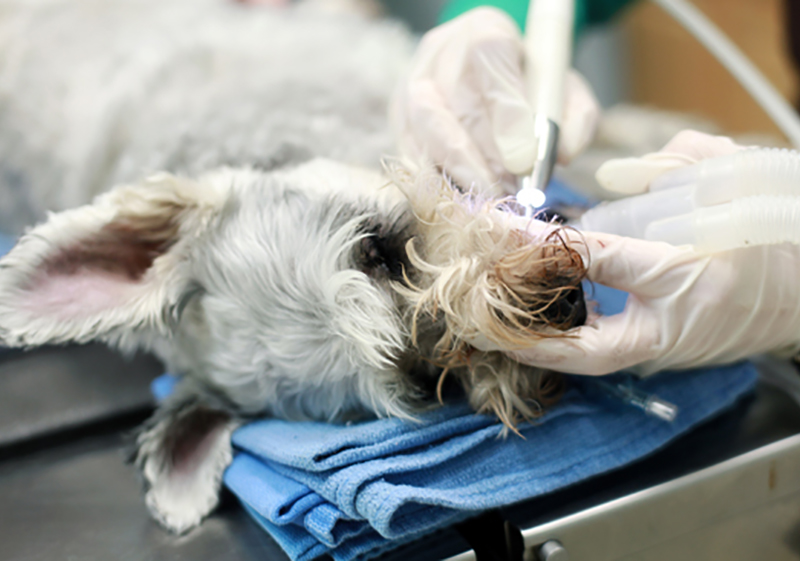
At LAVet Hospital, we recommend routine dental checkups for your pets. Poor dental hygiene can leave its mark on your pet. Surprisingly, bad breath (halitosis) is an abnormal condition in cats and dogs, often indicating a serious underlying condition called periodontal disease, which affects the mouth, gums, and teeth.
Periodontal Disease
Periodontal disease is the most common medical disorder among pets nationwide, affecting more than 80 percent of dogs and 70 percent of cats by age three. If left untreated it can develop into serious health problems. Advanced dental disease significantly impacts your pet’s quality of life, leading to oral pain that makes feeding difficult and resulting in chronic discomfort. In some cases, harmful bacteria originating in the mouth can enter the bloodstream, causing serious complications of the heart, kidneys, and liver, as well as other systemic disorders.
Preventative Dental Care
Fortunately, due to its generally slow rate of progression, dental disease is exceedingly preventable. Just like in humans, a good oral health routine is key to avoiding most types of periodontal disease. The first (and best) line of defense in preventative dental care are exams and cleanings. In addition to comprehensively evaluating your pet’s oral health, these appointments consist of hand scaling and curettage to remove plaque and tarter, polishing and rinsing, improving tooth and gum health significantly.
Veterinary dentistry has developed rapidly over the past fifteen years and is now approaching the same sophisticated techniques that are available in human dentistry. Research has proven that pets who have received modern veterinary dental procedures and professional cleanings have an increased lifespan and quality of life.
Dental Nerve Blocks
LAVet Hospital is committed to providing the highest level of comfort to our patients during every stage of oral treatment.
Nerve blocks are a class of anesthetics administered to your pet during oral surgery to minimize discomfort during and immediately following the procedure. These are important components to overall pain management, reducing post-operative side effects like hypertension by easing the recovery period.
Local blocks are used to remove pain sensation from the targeted area of the mouth, often being used in conjunction with other systemic pain medication to maximize effectiveness. Your pet will never feel undue pain or discomfort during their stay at our hospital.
Tooth Extractions
Tooth extractions are very common procedures that provide much-needed relief for our patients. While we try to provide alternative treatments first, dental extractions are necessary when oral disease or infection cannot be controlled by any other method.
Common removal situations include:
-
Fractured teeth that are causing pain and are at risk of infection.
-
Tooth and its supporting structures have been rendered unusable by periodontal disease.
-
Making room for more important teeth by removing smaller secondary teeth, this makes the entire dental system more stable.
Types of extractions:
-
Single root. These simple extractions occur when the tooth, crowns, and roots can be removed in one section. This is a simple and easy procedure that requires little surgical intervention, only needed to properly close the extraction site.
-
Surgical and multi-rooted. Due to the anatomical makeup of canine and feline teeth, surgical extractions are often required. A cat and dog’s teeth have deep roots that are tightly connected to the surrounding tissue. Due to these complex structures, surgical extractions are the safest and preferred method of removal for pets. A small incision is made to release the roots at their base and the surrounding tissue is cleaned out and treated, the tooth is removed, and the incision is sutured closed.
The recovery process for extractions is relatively quick, with many patients being able to eat soft food soon after the procedure, and back to full health within several days.
Oral Mass Removals
While often not externally apparent, cats and dogs are at risk of tumors inside their mouths. Representing a sizable percentage of all cancerous masses in pets, oral tumors appear in the bone, teeth or soft tissue of the upper and lower jaw, tongue, or throat.
While tumors can be benign, their malignant counterparts necessitate that all oral growths be investigated. A biopsy is performed, and the tissue is used to determine what type of mass it is. Tumors exist in a large variety of forms, each with specific characteristics. The most common types of oral malignant tumors are melanoma, carcinoma, fibrosarcoma, and osteosarcoma. For most oral tumors, surgical removal is the most effective treatment.
Oral mass removals depend on the type, size, and location of the tumor. Depending on the circumstances, tumors may be excised by themselves, or with a section of the surrounding area to ensure all malignant tissue is removed.
How can I help my pet?
Visual checks are a great, proactive way to discover oral masses in their early stages. Weekly inspections are recommended to note changes if uncharacteristic swelling is observed please contact LAVet Hospital immediately.
LAVet Hospital provides dental care to pets in Thibodaux, Houma, Raceland, Lockport, Chackbay, and everywhere in between.